
Definition
In the ordinary sense, a knife is a bladed instrument intended for cutting, with a handle or some part that allows it to be held in the hand.
“In the ordinary sense” matters. Trades, museums and some specialist texts also call “knives” objects that do not quite fit this definition; these uses are very real, but they lie outside everyday usage.
What makes a knife
It takes a blade, something to hold it by, and the whole must be made for cutting.
The blade is the working part of the object. It carries the cutting edge, also simply called the edge: the thinned border that cuts. An edge is recognized by its shape and its function, not by how sharp it is. A dull knife cuts poorly, but it is still a knife.
The handle is the part held in the hand. It can be made of added pieces, for example scales fixed on either side of the metal, or be nothing more than an extension of the piece that forms the blade. A one-piece knife, whose blade and grip form a single piece, is therefore still a knife even without scales; some models are in fact sold with optional scales. The different ways of fitting a handle are explained with the anatomy of the knife, in chapter I.02.
That leaves use. Cutting is often done by pressing, with or without sliding the blade across the material, but the definition does not require any particular motion: it says only that the object is made for cutting.
What can vary
None of the following features is necessary for an object to be a knife.
- The blade can be fixed or fold: a folding pocket knife is just as much a knife as a kitchen knife (see I.01.06).
- The tip can be pointed or rounded: the round-tipped table knife has no point.
- The edge can be plain or serrated: the serrated knife is a knife.
- The blade can have one cutting edge or two. A single edge is common, but there are knives with two edges, such as the tripe seller’s knife cited by the Académie française in 1740. The rule “one edge for a knife, two for a dagger” is therefore not absolute (see I.01.04).
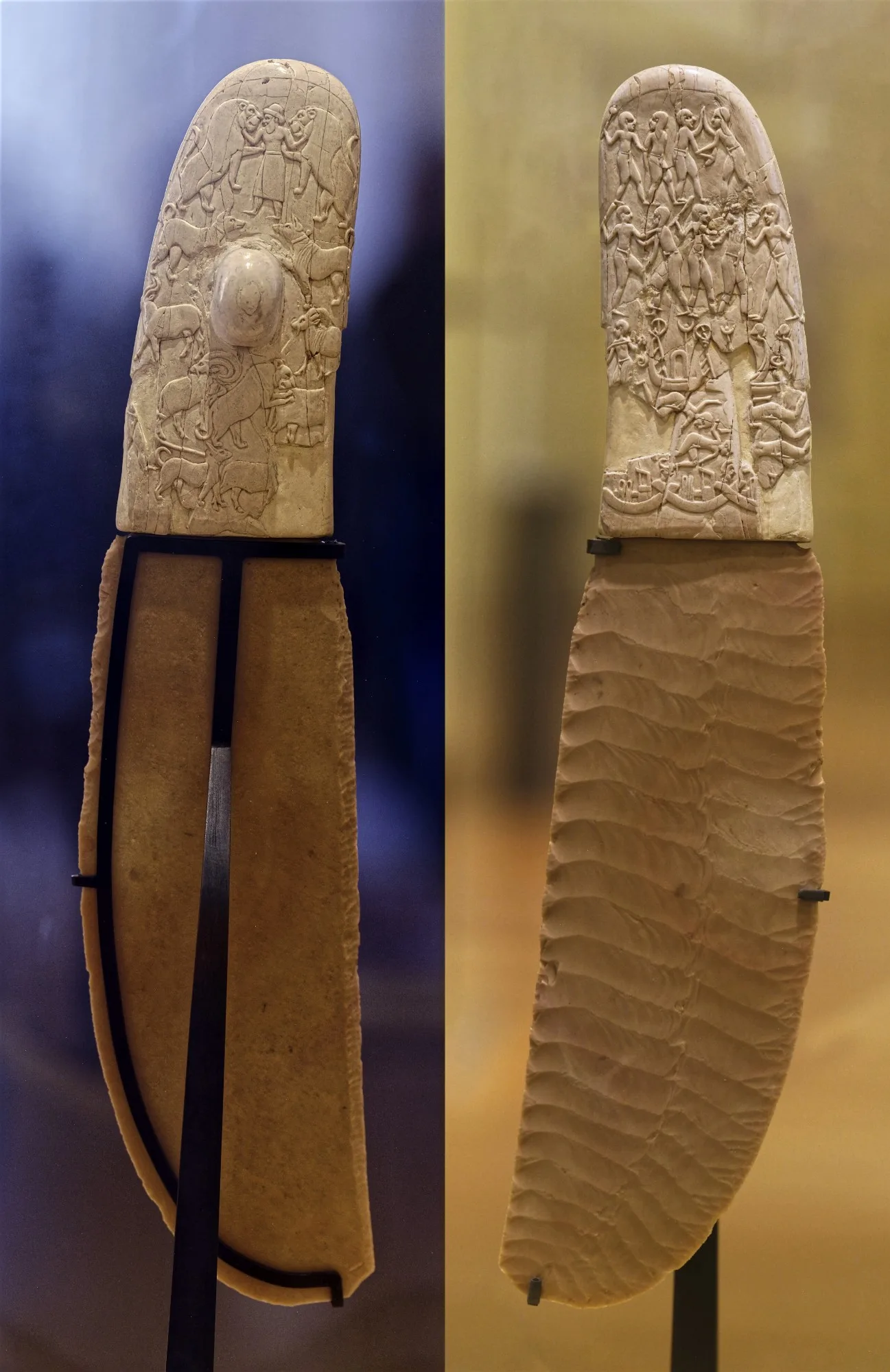
- Steel is common, but not required. An international standard, ISO 8442-9:2018, covers knives with ceramic blades. The Louvre also holds, under number E 11517, a knife with a flint blade and an ivory handle, known as the “Gebel el-Arak” knife. Its style dates it to the Naqada II period, around 3600–3200 BC; its provenance, however, is known only from the seller’s statement.
- Neither shape nor length is fixed. The Trésor de la langue française speaks of a blade “of variable shape and length” (our translation), and none of the dictionaries consulted gives a minimum or maximum size.
Older definitions were narrower. In 1694, the Académie française required an instrument of iron mixed with steel, sharp on one side only; both requirements disappear from its definition in 1762. This change concerns the wording of the dictionary: on its own, it does not allow us to date any change in the knives themselves.
Five examples to test the definition
| Object | A knife in the ordinary sense? | What the example shows |
|---|---|---|
| Kitchen knife | Yes | The knife is not reserved for the table. |
| Folding pocket knife | Yes | The blade does not need to be fixed. |
| Round-tipped table knife | Yes | A point is not necessary. |
| One-piece knife without scales | Yes | The handle does not need to be an added piece. |
| Loose blade, intended to be mounted | No, it is a component | A spare part is not the complete instrument. |
Related objects
Several instruments have, like the knife, a blade, a cutting edge and a part held in the hand, yet bear their own names: the razor; the box cutter, which the Académie française describes as an instrument with a replaceable blade and a handle; or the bistoury, which the Trésor de la langue française defines as a knife-shaped surgical instrument, fixed or folding. The same dictionary also records a trade use of couteau (knife) to mean the razor. What sets these objects apart from the knife is covered in entry I.01.03.
Other cutting tools belong to different families. Scissors cut with two blades that cross. The saw also forms a family of its own, but its teeth are not enough to distinguish it from a knife, since serrated knives exist.
The boundary with the dagger, the poniard and the sword is examined in entry I.01.04. Likewise, the ritual function of an object is not enough to decide whether it falls within the ordinary sense of the word: that question belongs to entry I.01.05.
Finally, three questions must not be confused: how long the word couteau has existed, how long the objects so named have existed, and how long human beings have been making cutting tools. Nothing supports the claim that the knife was “humankind’s first tool”; the emergence of cutting tools is the subject of entry I.01.02.
Other uses of the word
Some trades also use the word couteau (knife) for bladed tools used mainly for spreading, scraping or coating: the painter’s palette knife, and the knives of the glazier, the mason or the gilder. The Académie française classes these uses under an analogical sense, distinct from the word’s literal sense. Depending on the tool, the blade is more or less sharp.
Specialist disciplines also have their own “knives”, defined by their own criteria. In archaeology, the couteau à dos (backed knife) is a category of knapped stone pieces, not to be confused with the simple back of a knife blade. In French law, the Code de la sécurité intérieure (Internal Security Code) defines the arme blanche (bladed weapon) and classifies certain knives, but these articles give no general definition of the word (see I.06.09 and volume XIV). Each of these classifications serves its own purpose, and none carries over into another.
The word
The French word couteau comes from Latin cultellus, a diminutive of culter, from which the French coutre also derives. The Trésor de la langue française records the form coltel around 1130, with the sense of “cutting tool” (our translation).
Sources
- Académie française, Dictionnaire de l'Académie française, 1st edition (1694), “couteau”: https://www.dictionnaire-academie.fr/article/A1C0677
- Académie française, Dictionnaire, 3rd edition (1740), “couteau”: https://www.dictionnaire-academie.fr/article/A3C2151
- Académie française, Dictionnaire, 4th edition (1762), “couteau”: https://www.dictionnaire-academie.fr/article/A4C2692
- Académie française, Dictionnaire, 8th edition (1935), “couteau”: https://www.dictionnaire-academie.fr/article/A8C3265
- Académie française, Dictionnaire, 9th edition, “couteau”: https://www.dictionnaire-academie.fr/article/A9C4689
- Académie française, Dictionnaire, 9th edition, “cutter”: https://www.dictionnaire-academie.fr/article/A9C5372
- ATILF, Trésor de la langue française informatisé, “couteau”: https://www.cnrtl.fr/definition/couteau/nom
- ATILF, Trésor de la langue française informatisé, etymology of “couteau”: https://www.cnrtl.fr/etymologie/couteau
- ATILF, Trésor de la langue française informatisé, “bistouri”: https://www.cnrtl.fr/definition/bistouri
- ISO 8442-9:2018, official page of the standard: https://www.iso.org/fr/standard/66329.html
- Musée du Louvre, Couteau du Gebel el-Arak, E 11517, collection record: https://collections.louvre.fr/en/ark:/53355/cl010007467
- ESEE Knives, Izula model page (optional handle scales), cited only as an example of a knife usable without scales: https://www.eseeknives.com/product/izula
- D. de Sonneville-Bordes and J. Perrot, “Lexique typologique du Paléolithique supérieur”, Bulletin de la Société préhistorique française, 53-9, 1956, p. 547: https://www.persee.fr/doc/bspf_0249-7638_1956_num_53_9_3374
- Code de la sécurité intérieure, article R311-1, I, 10° (Légifrance): https://www.legifrance.gouv.fr/codes/article_lc/LEGIARTI000052208381/2026-05-13
- Code de la sécurité intérieure, article R311-2, version in force since September 7, 2025 (Légifrance): https://www.legifrance.gouv.fr/codes/article_lc/LEGIARTI000047786747
Share this article
- Share by email
- Share on WhatsApp (opens in a new tab)
- Share on Telegram (opens in a new tab)
- Share on Facebook (opens in a new tab)
- Share on Pinterest (opens in a new tab)
- Share on X (opens in a new tab)
- Share on LinkedIn (opens in a new tab)
- Share on Bluesky (opens in a new tab)
- Share on Reddit (opens in a new tab)
Comments
No comment yet.
Leave a comment
No account is needed. Comments are published after review by the team.
Your name and your comment are published once approved; no e-mail address is asked. To limit abuse, a fingerprint of your IP address, computed with a secret key, is kept ten minutes with your comment, and with your report until the team decides. To have one of your comments removed, contact us. Contact us