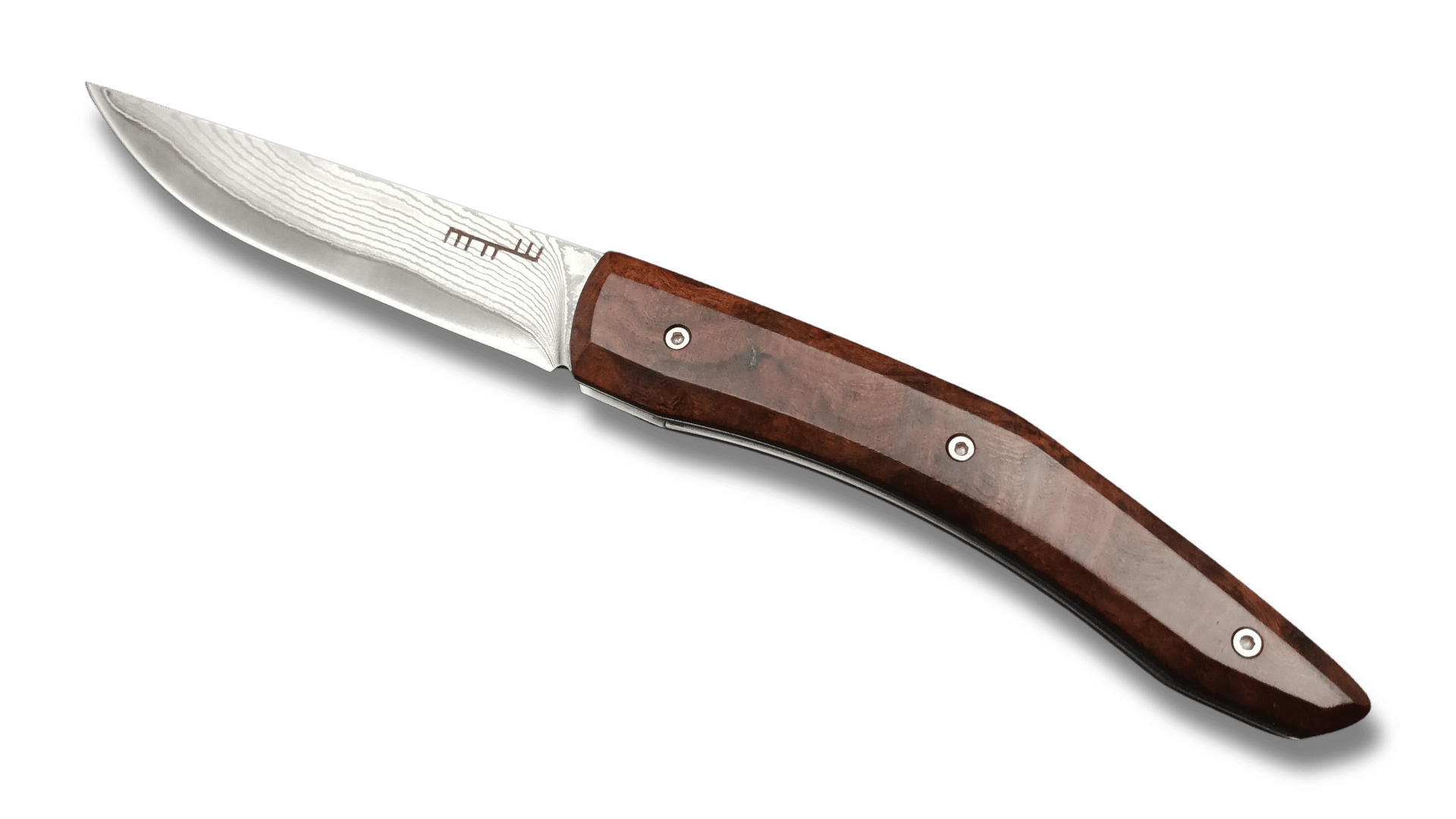

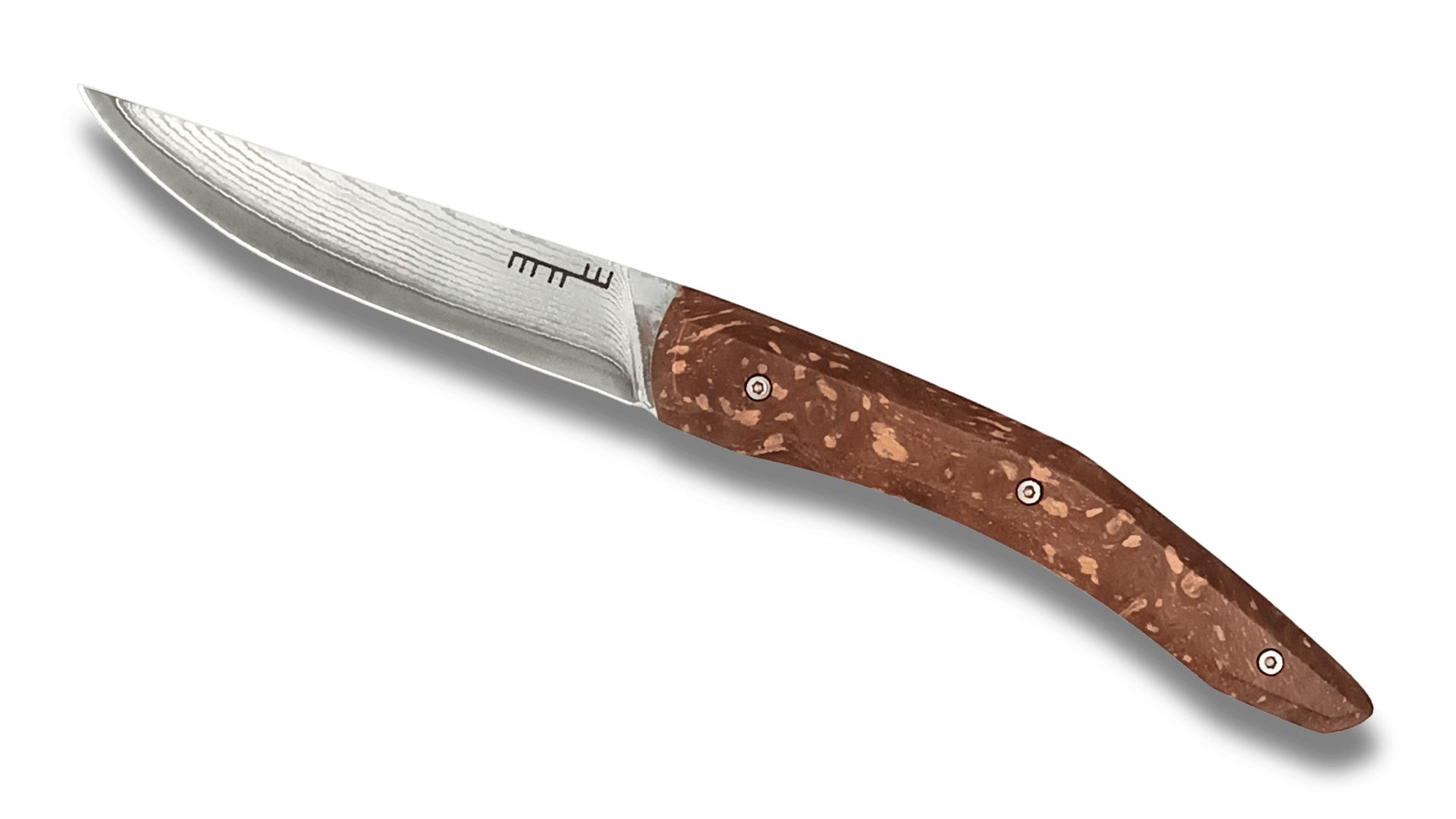
What is a damascus blade knife?
A knife whose blade is made of steel composed of several layers assembled and then worked, which reveals a pattern in the material. This pattern passes through the steel: it is not engraved on the surface. In the workshop, two families coexist: the stainless Damasteel damask, used mainly, and the damascus hand-forged by colleagues, used occasionally.
Does a Damascus blade cut better than classic steel?
No, not by nature. Cutting quality depends on the steels used, heat treatment, blade geometry, grinding and sharpening — not the pattern. A well-designed and well-treated damascus cuts like very good steel; a neglected damask cuts poorly. The pattern is an aesthetic and graphic choice, not a promise of performance.
What is the difference between Damasteel and artisanal damask?
Damasteel is a stainless damask produced industrially in Sweden, with precise patterns and great regularity. Artisanal damascus is forged by a cutler or blacksmith, with variations specific to his hand. Two manufacturing logics, not a hierarchy. I mainly use Damasteel and I reserve my colleagues’ damask for projects where this material is really useful for the knife.
Can a stainless damask rust?
It is highly resistant to corrosion, but it is not invulnerable. Prolonged humidity, acidic residue left on the blade or trips to the dishwasher can end up marking it. In practice, hand washing followed by drying is enough to keep the blade in good condition for years of regular use.
How to maintain a damascus knife?
Hand wash, dry after use, no dishwasher, no prolonged stay in humidity. For a folding machine, a mechanism kept clean. Regular sharpening maintains the edge as with any artisanal blade. These gestures take less time than reading this response; the details are given in the guide to maintaining an artisanal knife.
Are all the patterns on a damascus blade unique?
Not in the strict sense for Damasteel: the pattern families are defined by the manufacturer. On the other hand, the positioning of the pattern on the blade, its revelation and its integration into the geometry of the knife create variations from one piece to another. Artisanal damask follows another logic: each forged bar bears the variations specific to the blacksmith's work.
Are FL Toussaint damascus knives entirely made in the workshop?
Parts other than series models, yes: complete manufacturing in the Courpière workshop. On certain series models only, heat treatment or preparatory grinding can be entrusted to specialized partners. The design, adjustment, assembly, finishing, sharpening and final inspection are in all cases carried out or controlled in the workshop.
Can a damascus knife be used every day?
Yes, that’s even what it’s made for. A stainless damascus blade supports regular use, at the table as well as in the kitchen, with simple maintenance. A damascus knife is not a museum piece by default: it cuts bread, cheese and vegetables like any other, provided you choose a model adapted to its use.