
In brief
A sharp stone edge makes it possible to prepare a material outside the mouth: slicing flesh from a carcass, detaching tissues, dividing plants, working wood. This is the best-attested use of the earliest cutting tools. Cut marks left on bones and the wear on the tools’ edges show it at several sites in East Africa that are 2 million years old or more.
These tools are far older than our own species, Homo sapiens. They were produced by hominins, that is, early members of the human lineage, such as australopithecines, paranthropines or the earliest Homo, without the species that made them having been identified. Knowing what these tools were used for does not tell us, either, why the technique appeared at that time. Several explanations are under discussion, and none has been demonstrated to be the sole cause.
What a sharp edge provides
A cutting tool is, first and foremost, an object with an edge that serves to cut. That edge is called the cutting edge; in French, tranchant, the “sharpened side of an instrument intended for cutting” according to the Trésor de la langue française (our translation), a word the Académie française associates with fil (edge).
The oldest known cutting tools are flakes, that is, fragments detached from a block of stone, the core, by striking it with another stone. Certain rocks, such as flint or obsidian, fracture in such a way that the break can leave a thin edge, usable right away, without retouch or a handle. This edge concentrates the force on a very small area, which helps separate the material. Its effectiveness also depends on the stone, the angle of the edge, its condition and the motion; the mechanics of cutting have their own entry, I.04.01.
In the earliest tool assemblages, it is generally the flake that carries the useful edge, even though the block it came from and the stones used for striking may have had uses of their own.
Such an edge makes it possible to process a material outside the mouth, before eating it or putting it to use. Hominins do not have the sharp teeth of carnivores, called carnassials, which does not mean they could not eat meat. The flake gave them one more way to prepare food and materials.
What the remains show
Two kinds of evidence shed light on how the first cutting edges were used. Cut marks on bones indicate that a carcass was worked with a sharp edge. Use-wear analysis, which studies the wear left on the edge of a tool, makes it possible to identify the material worked by comparing that wear with the wear produced in experiments.
The Nyayanga site, in Kenya, has yielded a tool assemblage dated to a range of 3.032 to 2.581 million years ago. The authors of the study describe two hippopotamid butchery sites there, along with wear left by working plant and animal tissues. The stones there were also used for striking or pounding, more often than in later assemblages of the same tradition. These remains attest that large carcasses were cut up; they do not say how the carcasses had been obtained, and nothing here makes it possible to decide between hunting and scavenging.
At Kanjera South, also in Kenya, around 2 million years ago, a use-wear study examined 62 quartz and quartzite objects, after a blind test of the method. Of the 23 edges whose use could be determined, 16 bear wear left by plants (wood, underground plant organs, grass or sedge stems) and 7 by animal materials.
The first cutting edges were therefore not used only for meat. This count does not, however, measure the share of plants in the diet, nor the full range of activities: it covers only the edges whose use could be identified, and only one site. An edge that worked wood was not necessarily preparing a meal, either; it may have served to shape another object. More broadly, these analyses rest on few sites and few pieces, and depend as much on how well the edges are preserved as on the experimental reference collections.
Sharp edge, manufacture and use
Faced with a stone edge, three questions arise, and they do not necessarily have the same answer: can this edge cut? Was it produced on purpose? Was it actually used to cut? Living primates show why it is better not to mix these questions up.
In Brazil, in the Serra da Capivara, capuchins (Sapajus libidinosus) strike stones against quartz cobbles. Without seeking to, they detach sharp flakes that partly resemble hominin tools, and the published observations do not show them using these flakes to cut. Producing a sharp edge is therefore not unique to the human lineage: it can be the by-product of an entirely different activity.
The bonobo Kanzi, in captivity, illustrates the opposite case. Human demonstrations taught him to detach flakes, which he used to cut a cord and to open a box containing a reward. His mastery of the motion came gradually.
| Case | The edge can cut | Produced on purpose | Used to cut |
|---|---|---|---|
| Flakes from the Serra da Capivara capuchins | Yes, for some | No: by-product of percussion | Not observed |
| Kanzi’s flakes, in captivity | Yes | Yes, after learning | Yes, cutting a cord |
| Edges analyzed at Kanjera South | Yes | Inferred from context, not observed | Inferred from wear, for 23 edges |
| Pieces from Lomekwi 3 | Depending on the piece | Knapping proposed by the discoverers | Not established |
These cases suggest a possible sequence: flakes produced by accident, then picked up, then made deliberately. This is only a scenario, and no known site shows this transition step by step.
The oldest known traces
The ages below, in millions of years (Ma), are those of the oldest published attestations. They do not date the invention of cutting tools: older tools may not have been found yet, and the age of a layer does not say who knapped the stones.
| Site | Published age | What has been published | Limitation |
|---|---|---|---|
| Dikika (Ethiopia) | More than 3.39 Ma | Two bones bearing marks interpreted as cut marks and percussion marks | No associated tools; the origin of the marks is debated |
| Lomekwi 3 (Kenya) | About 3.3 Ma | Knapped stones attributed to a distinct industry, the “Lomekwian” | The link between the objects and the dated layers is debated |
| Nyayanga (Kenya) | 3.032–2.581 Ma | Flakes, hippopotamid butchery, wear from plant and animal materials | A range, not a precise date |
| Namorotukunan (Kenya) | Around 2.75, 2.58 and 2.44 Ma | Three levels with comparable tools | Ages estimated from the layers; similarity between levels, not proven continuity |
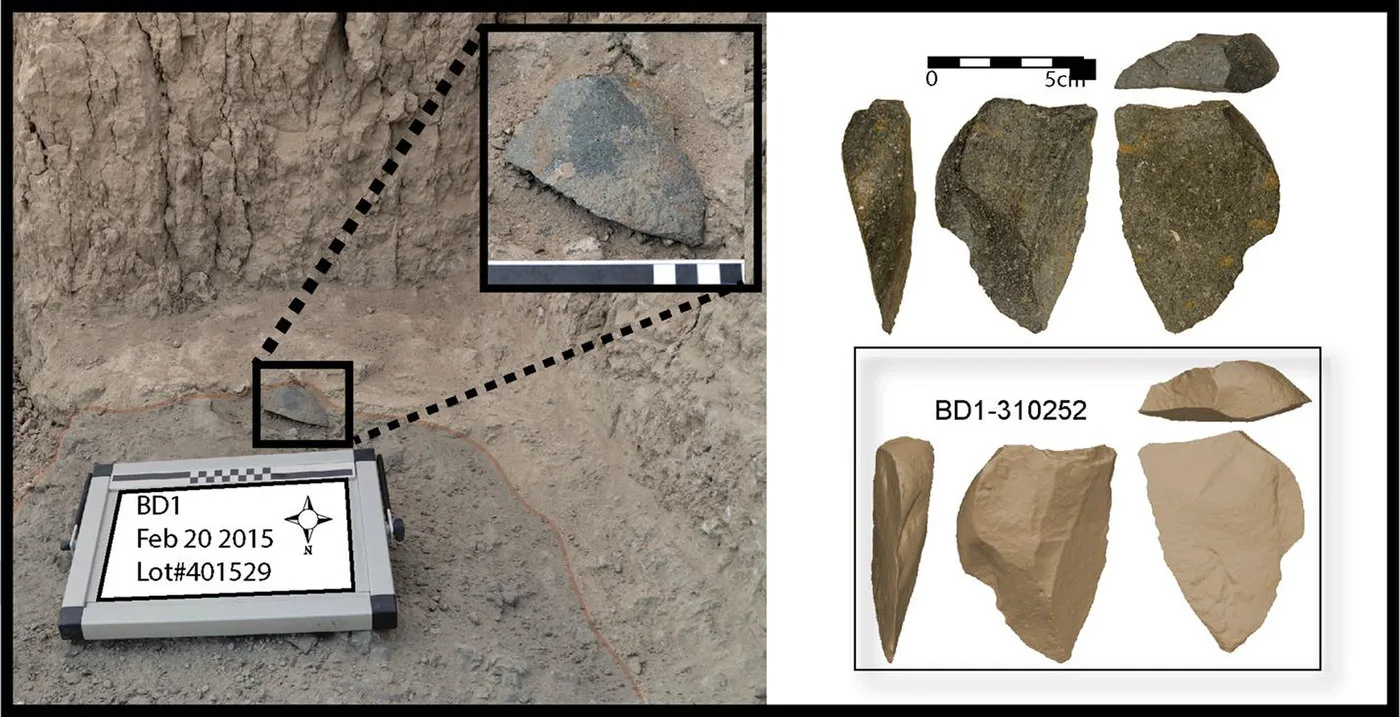
| Bokol Dora 1, Ledi-Geraru (Ethiopia) | 2.61–2.58 Ma | Flakes produced systematically | Does not identify the maker |
| Gona (Ethiopia) | 2.6–2.5 Ma | Historical benchmark for the oldest well-established tradition | Dated in 1997 |
Prehistorians call this tradition of flakes detached from blocks of stone the Oldowan. It is well established by around 2.6 Ma, and recent discoveries attest it earlier.

The two oldest cases do not raise the same question. At Lomekwi 3, the discoverers published in 2015 a knapping site about 3.3 Ma old, in a wooded setting, where flakes are said to have been detached and stones used for striking. Other researchers dispute the link between some of the objects and the dated layers; the discoverers have defended their analysis, and the debate is not settled.
At Dikika, no knapped stone has been found. The discussion concerns two bones: their discoverers see the marks on them as traces of cutting, while other researchers point, among other causes, to trampling. And even if these marks did come from cutting, they would show that an edge was used, not that it was made: naturally sharp stones could have been involved.
That leaves the question of the maker, still unanswered. At Nyayanga, Paranthropus teeth were found with the tools, but this association does not identify the knapper. The oldest fossil attributed to the genus Homo, a mandible from Ledi-Geraru, is dated to 2.80–2.75 Ma: that is the age of this fossil, not that of the genus’s first appearance, nor that of the first toolmaker.
Why at that time?
Knowing what a sharp edge is used for explains the value of the technique, not when it appeared. Nor do the remains, on their own, reveal the motivations of the first users. Several lines of explanation are being studied; none has been demonstrated to be the primary cause.
The dietary explanation draws on experiments with present-day humans. They show that cutting certain foods, such as meat, or pounding others, such as tubers, reduces chewing effort under the conditions tested. They shed light on a possible advantage of these actions, without demonstrating either the exact diet of the first users or the cause of the appearance of cutting edges.
Changes in the environment may have altered the resources available and the value of certain actions. The settings, however, differ from one site to another: a wooded setting at Lomekwi 3, a vegetation mosaic at Nyayanga, a changing local environment at Namorotukunan, where the same technique persists. No single climatic change has been demonstrated to be the cause of the first cutting edges.
As for learning, comparable techniques are found at Namorotukunan in three levels spread over about 300,000 years. This repetition shows that they persisted, not how they were passed on. Social learning remains a possible explanation. An experiment published in 2022 showed, however, that untrained present-day humans can rediscover knapping actions without copying them. This result does not measure the abilities of extinct species; it does, on the other hand, rule out claiming, on the strength of the objects alone, that transmission was necessary.
Nor do researchers agree on the number of inventions: some consider that stone knapping may have been invented several times, others stress the continuity of sites after 2.6 Ma, and the question is not settled.
Finally, a widespread idea holds that tools, by giving access to meat, “made the brain grow.” One version of this idea, the so-called “expensive-tissue” hypothesis (Aiello and Wheeler, 1995), posits that a larger brain was offset by a smaller gut, thanks to a richer diet. Yet a comparison of 100 mammal species, including 23 primates, did not find the expected relationship between brain size and gut size (Navarrete et al., 2011). This particular hypothesis comes out weakened, though without ruling out any role of diet in the evolution of the brain.
From cutting edge to knife
A raw flake can already cut, without retouch or a handle. The objects described here remain cutting tools: what makes an object a knife is covered in entry I.01.01, and the distinction between knife, blade and tool in entry I.01.03.
Composite tools, which combine a stone piece with a handle or a shaft, and metal tools belong to other stages in the history of technology. The known milestones do not trace a simple line leading from the flake to the knife; that history is the subject of entry I.01.11 and volume X.
Sources
- ATILF, Trésor de la langue française informatisé, “tranchant”: https://www.cnrtl.fr/definition/tranchant
- Académie française, Dictionnaire, 8th edition, “tranchant”: https://www.cnrtl.fr/definition/academie8/tranchants//0
- Semaw et al., “2.5-million-year-old stone tools from Gona, Ethiopia,” Nature, 385, 1997, pp. 333–336 (abstract): https://doi.org/10.1038/385333a0
- Braun et al., “Earliest known Oldowan artifacts at >2.58 Ma from Ledi-Geraru, Ethiopia, highlight early technological diversity,” PNAS, 116 (24), 2019, pp. 11712–11717: https://doi.org/10.1073/pnas.1820177116
- Plummer et al., “Expanded geographic distribution and dietary strategies of the earliest Oldowan hominins and Paranthropus,” Science, 379, 2023, pp. 561–566 (abstract): https://doi.org/10.1126/science.abo7452
- Braun et al., “Early Oldowan technology thrived during Pliocene environmental change in the Turkana Basin, Kenya,” Nature Communications, 16, 9401, 2025: https://www.nature.com/articles/s41467-025-64244-x
- Harmand et al., “3.3-million-year-old stone tools from Lomekwi 3, West Turkana, Kenya,” Nature, 521, 2015, pp. 310–315 (abstract): https://doi.org/10.1038/nature14464
- Lewis and Harmand, “An earlier origin for stone tool making: implications for cognitive evolution and the transition to Homo,” Philosophical Transactions of the Royal Society B, 371, 20150233, 2016: https://pmc.ncbi.nlm.nih.gov/articles/PMC4920290/
- Domínguez-Rodrigo and Alcalá, “Pliocene Archaeology at Lomekwi 3? New Evidence Fuels More Skepticism,” Journal of African Archaeology, 17 (2), 2019, pp. 173–176 (bibliographic record): https://doi.org/10.1163/21915784-20190006
- Harmand et al., “Reply to Domínguez-Rodrigo and Alcalá: Interpretation Without Accurate Evidence Is Fantasy,” Journal of African Archaeology, 17 (2), 2019, pp. 177–181 (excerpts): https://doi.org/10.1163/21915784-20190007
- Archer, Aldeias and McPherron, Journal of Human Evolution, 142, 102740, 2020 (excerpt): https://doi.org/10.1016/j.jhevol.2020.102740
- McPherron et al., “Evidence for stone-tool-assisted consumption of animal tissues before 3.39 million years ago at Dikika, Ethiopia,” Nature, 466, 2010, pp. 857–860 (abstract): https://doi.org/10.1038/nature09248
- Domínguez-Rodrigo, Pickering and Bunn, PNAS, 107 (49), 2010, pp. 20929–20934 (abstract): https://doi.org/10.1073/pnas.1013711107
- McPherron et al., letter, PNAS, 108, 2011, E116: https://pmc.ncbi.nlm.nih.gov/articles/PMC3102392/
- Domínguez-Rodrigo, Pickering and Bunn, Journal of Archaeological Science, 39, 2012, pp. 205–214 (abstract): https://doi.org/10.1016/j.jas.2011.03.010
- Lemorini et al., “Old stones' song: Use-wear experiments and analysis of the Oldowan quartz and quartzite assemblage from Kanjera South (Kenya),” Journal of Human Evolution, 72, 2014, pp. 10–25 (abstract): https://doi.org/10.1016/j.jhevol.2014.03.002
- Proffitt et al., “Wild monkeys flake stone tools,” Nature, 539, 2016, pp. 85–88 (abstract and figure captions): https://doi.org/10.1038/nature20112
- Toth and Schick, “The Importance of Actualistic Studies in Early Stone Age Research,” in The Cutting Edge, Stone Age Institute Press, 2009, ch. 13, pp. 270–271: https://stoneageinstitute.org/pdfs/cutting-edge-ch13-toth-schick.pdf
- Villmoare et al., Science, 347, 2015, pp. 1352–1355 (abstract): https://doi.org/10.1126/science.aaa1343
- Zink and Lieberman, “Impact of meat and Lower Palaeolithic food processing techniques on chewing in humans,” Nature, 531, 2016, pp. 500–503 (abstract): https://doi.org/10.1038/nature16990
- “Early knapping techniques do not necessitate cultural transmission,” Science Advances, 8, eabo2894, 2022 (abstract and passages): https://doi.org/10.1126/sciadv.abo2894
- de la Torre, “Searching for the emergence of stone tool making in eastern Africa,” PNAS, 116 (24), 2019, pp. 11567–11569: https://pmc.ncbi.nlm.nih.gov/articles/PMC6575166/
- Aiello and Wheeler, Current Anthropology, 36 (2), 1995, pp. 199–221 (abstract): https://doi.org/10.1086/204350
- Navarrete, van Schaik and Isler, Nature, 480, 2011, pp. 91–93 (abstract): https://doi.org/10.1038/nature10629
Share this article
- Share by email
- Share on WhatsApp (opens in a new tab)
- Share on Telegram (opens in a new tab)
- Share on Facebook (opens in a new tab)
- Share on Pinterest (opens in a new tab)
- Share on X (opens in a new tab)
- Share on LinkedIn (opens in a new tab)
- Share on Bluesky (opens in a new tab)
- Share on Reddit (opens in a new tab)
Comments
No comment yet.
Leave a comment
No account is needed. Comments are published after review by the team.
Your name and your comment are published once approved; no e-mail address is asked. To limit abuse, a fingerprint of your IP address, computed with a secret key, is kept ten minutes with your comment, and with your report until the team decides. To have one of your comments removed, contact us. Contact us